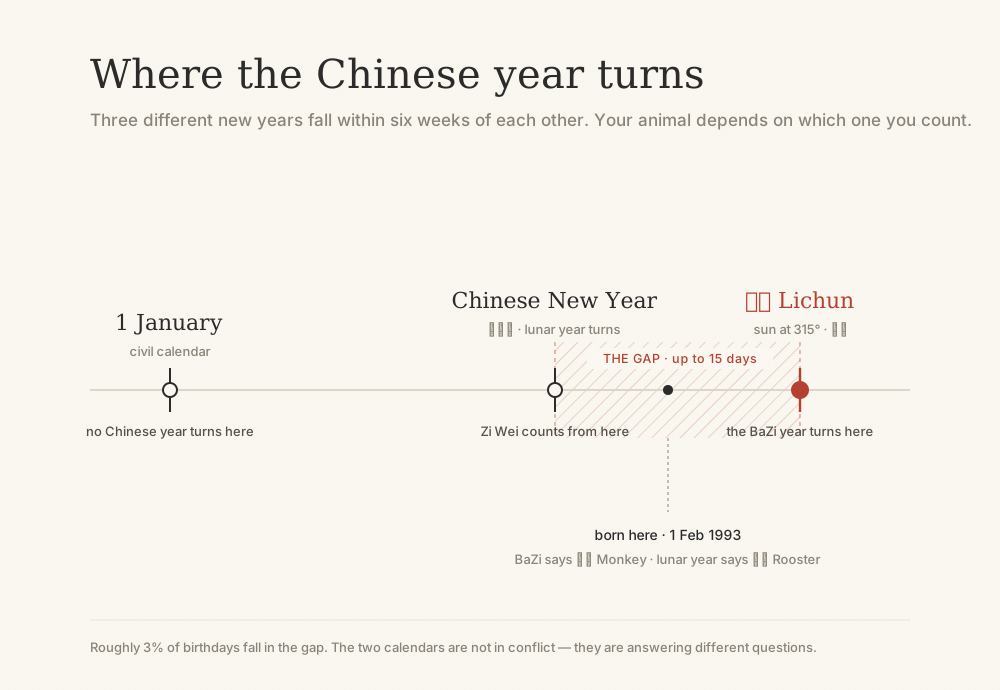
Every February we answer the same letter, usually from someone born in the last week of January or the first week of February: one calculator says I am a Rooster, another says I am a Monkey. Which is it?
Neither calculator is broken. They are counting different new years. Chinese timekeeping has three of them, they sit within about six weeks of each other, and if your birthday falls in the gap your animal genuinely depends on which system is asking.
The short answer
For a BaZi (Four Pillars) chart, the year — and therefore the animal, the guardian figure and the 太岁 relation for the year — turns at 立春 Lichun, the moment the sun reaches 315° of ecliptic longitude. That usually falls on 3–5 February.
For the lunar calendar — Chinese New Year, most almanacs, and the Zi Wei Dou Shu chart — the year turns at 春节, which can fall anywhere from 21 January to 20 February.
So for the two or three weeks a year when Chinese New Year comes first, a person has one animal in BaZi and another in the lunar count. Roughly 3% of birthdays land in that window. Both readings are internally consistent; they are answering different questions.
Three new years, six weeks apart
| Marker | What actually turns | Which system counts from it |
|---|---|---|
| 1 January | Nothing in the traditional calendar — the Gregorian year is a modern import here. | Civil records only. No Chinese chart uses it. |
| 春节 Chinese New Year new moon, 2nd after winter solstice | The lunar year number, and with it the popular animal of the year. | Zi Wei Dou Shu, most zodiac calculators, newspapers, red envelopes. |
| 立春 Lichun sun at 315° | The BaZi year pillar — and with it the month pillar's starting stem, the year's ten-god, and the 太岁 of the year. | Four Pillars, 大运 luck cycles, flying star, anything that reads a chart. |
Why the pillar year waits for 立春
BaZi is built on the 24 solar terms (节气), not on lunar months. Each of the twelve solar months begins at a 節 — 立春 for the first month (寅), 惊蛰 for the second, and so on — and those markers are defined by the sun's position, not by the moon. The year pillar uses the same clock: the year changes when the sun changes, at 315°.
That is not a later correction or an astrologer's opinion. It is why the month pillar for anyone born in the second half of January already belongs to the new solar year even though the lunar year has not turned. The two systems were never meant to agree on the boundary, because one tracks the moon and the other tracks the sun.
The exact minute matters
Because 立春 is an astronomical instant rather than a date, a birth on the right day can still fall on either side of it. These are the computed instants for a run of recent years, using a truncated VSOP87 solar longitude with ΔT correction — accurate to under two minutes, which is far tighter than the day-level tables most almanacs print.
| Year | 立春 in Beijing (UTC+8) | Same instant in New York |
|---|---|---|
| 1990 | 4 Feb, 10:14 | 3 Feb, 21:14 |
| 1993 | 4 Feb, 03:37 | 3 Feb, 14:37 |
| 1996 | 4 Feb, 21:07 | 4 Feb, 08:07 |
| 2000 | 4 Feb, 20:40 | 4 Feb, 07:40 |
| 2005 | 4 Feb, 01:43 | 3 Feb, 12:43 |
| 2010 | 4 Feb, 06:47 | 3 Feb, 17:47 |
| 2015 | 4 Feb, 11:58 | 3 Feb, 22:58 |
| 2020 | 4 Feb, 17:03 | 4 Feb, 04:03 |
| 2021 | 3 Feb, 22:58 | 3 Feb, 09:58 |
| 2024 | 4 Feb, 16:27 | 4 Feb, 03:27 |
| 2025 | 3 Feb, 22:10 | 3 Feb, 09:10 |
| 2026 | 4 Feb, 04:02 | 3 Feb, 15:02 |
New York column uses the offset in force on that date (EST, UTC−5). In a US summer birth, the same 立春 comparison would use EDT.
The time-zone trap
The single most common mistake in zodiac calculators is comparing a local birth time with a Beijing-time 立春. 立春 is one instant on Earth; your birthday is a wall-clock reading in one place. They only meet after one of them is converted.
Take 3 February 1993 in New York. 立春 that year was 14:37 New York time — 03:37 the next morning in Beijing.
- Born 12:00 in New York that day: 14:37 has not arrived, so the pillar year is still 壬申 — Water Monkey.
- Born 21:00 the same evening: 立春 passed seven hours earlier, so the pillar year is 癸酉 — Water Rooster.
Same city, same date, same hospital. Two different animals, nine hours apart, because the year turns at an instant and not at midnight. A calculator that reads the date alone gets this wrong for everyone born that evening.
The reverse case is just as common. In 2021, 立春 arrived on 3 February at 22:58 Beijing time, nine days before Chinese New Year (12 February). Someone born in Shanghai at 23:30 that night is, in BaZi, already a 辛丑 Ox — while every newspaper that week was still calling it the Year of the Rat, and correctly so, because the lunar year had not turned.
What true solar time does and does not change
Our true solar time correction adjusts a clock reading for longitude and the equation of time. It decides which two-hour hour pillar you fall into, and across midnight it can move the calendar day.
It does not change the 立春 test. That comparison is made in absolute time — UTC — so once your birth moment is pinned down, converting it to solar time cannot move you across 立春. What can move you is the time zone you were born in, which is why we ask for a birthplace, and why a missing birthplace is now read as New York time rather than Beijing time.
Three worked examples
| Birth | BaZi year pillar | Lunar-year animal | Why |
|---|---|---|---|
| 3 Jan 1993, 12:00, Shanghai | 壬申 · Monkey | Monkey | Before both markers — no disagreement. |
| 1 Feb 1993, 12:00, Shanghai | 壬申 · Monkey | Rooster | Chinese New Year was 23 Jan; 立春 had not come. |
| 3 Feb 2021, 23:30, Shanghai | 辛丑 · Ox | Rat | 立春 passed at 22:58, nine days before Chinese New Year. |
The first row is the ordinary case and the one most people expect. The second and third are the ones that generate support emails.
What we do on this site
We keep both traditions and label which is which, rather than forcing them into agreement:
- Zodiac animal, guardian figure, 2026 太岁 note, and every product match follow the Four Pillars — the 立春 reading. The animal shown on your result page is always the BaZi one.
- The Zi Wei Dou Shu chart keeps its own lunar-year stem, because its four transformations (四化) are derived from that stem. Forcing the BaZi stem in would silently misplace every 化禄 and 化忌 on the chart.
- When the two disagree, the result page says so in a short note under the Zi Wei chart, instead of leaving you to spot two animals and wonder.
Questions people actually ask
So which animal am I? For anything chart-based — BaZi, luck cycles, 太岁, the guardian figure — use the 立春 animal. For a red envelope, a school project or a newspaper feature, the lunar animal is the one everyone else is using. If you want the number for your own birthday, the element quiz computes it from your date, time and place.
Is 立春 always 4 February? No — it moves between 3 and 5 February, and the time moves by roughly six hours each year, which is why the table above has both 3 February and 4 February entries. The date alone is not enough to place a birth.
Does the hour really matter for the animal? Only near the boundary. If you were born within a day of 立春 and know your birth hour, it decides the year pillar. Otherwise it decides your hour pillar, which is a separate question.
Does changing the year pillar change anything else? Yes — the month pillar's starting stem is derived from the year stem (五虎遁), and the year stem is one of the ten gods read against your Day Master. It is not a label swap; it can shift a reading by one grade in a given area.
Why not just pick one system and use it everywhere? Because the systems were built to answer different questions. BaZi reads seasonal climate; Zi Wei maps palaces and transformations. Each needs its own calendar anchor to stay coherent — which is exactly what the two boundaries provide.
Read next
If the calendar question is settled, the next one is usually about the hour: why two cities at the same clock time have different hour pillars. For the wider frame, start with what BaZi actually is, or see what the twelve animals meant before they became a personality test.
Want this read on your own chart?
Two minutes, full birth data, no email needed — see which element your chart can actually use.
Keep reading
Which bracelet for your element?
A straight table from element to stone to bracelet — and the one mistake almost everyone makes first.
Read the article → CulturePixiu: the beast that eats and never lets go
What the winged lion actually is, why it has no exit, and which wrist the tradition puts it on.
Read the article → StudioHow we string, in Hangzhou
Cord, knots, and the checks every bracelet passes before it ships.
Read the article →