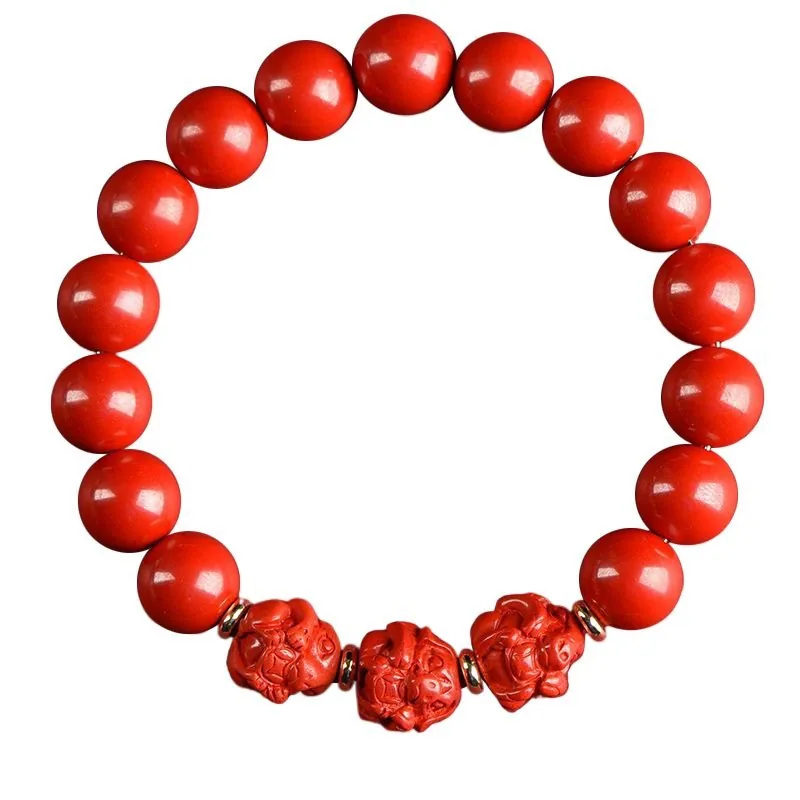
Ask ten people in a Chinese jewellery market what a pixiu is and you will get ten stories. Ask a museum curator and you get a correction: the pixiu (貔貅) is not a piece of jewellery at all, and never was. It is an idea about appetite that has been carved into jade, cast in bronze, painted on military banners and eventually strung on an elastic cord — and every version keeps the same joke at its centre.
First: it is not really a lion
The classical description is a composite animal: the head of a dragon, the body of a horse, the feet of a qilin, a pair of wings, and a tail that curls like a cloud. In the Han dynasty the word appears as a name for a kind of fierce, unbeatable troop — the Shiji (史记) uses the phrase 如虎如貔, "like a tiger, like a pixiu," to describe an army that cannot be broken. The beast started as a battle standard: a symbol of terrifying strength, painted on the flags of an advancing column.
Somewhere along the way it changed job. From the Ming and Qing onward the pixiu appears above shop doors, on the handles of seals, and in the windows of gold merchants. The same creature that once frightened enemies was retrained to attract what comes in and hold what has arrived.
The joke in the anatomy
The folklore version is short and specific: the pixiu has a mouth and no anus (有口无肛). It eats gold, silver and jewels, and it cannot let them out. That anatomical detail is the whole point — it is a comic exaggeration, not theology. People repeat it because it is memorable, and because it says exactly what a shopkeeper wants said about money: it comes in, and it stays.
Which hand, which way it faces
The popular rule is 左进右出 — left in, right out. The body is imagined as a circuit: the left side receives, the right side releases. A wealth-attracting piece therefore goes on the left wrist. If you wear only one bracelet all day and want the practical answer, that is the one most Chinese vendors will give you.
The second rule is about the head. Tradition says the pixiu's head should point outward — away from your body, toward the room, the door, the world it is supposed to gather from. On a wrist that means the head sits at the outer edge of the band, not tucked against the arm.
The honest footnote: the left/right rule belongs to the modern commercial layer of the tradition, not to classical texts. If it does not move you, wear it on the non-dominant wrist, where it survives longer — that advice is at least measurable. Our full explanation of the custom is in which wrist to wear.
The stone changes the meaning
A pixiu is the same shape in every version we make; what changes is the material, and the material is what ties the piece to a five-element reading. In our own shop that gives four distinct options:
| Material | Element | Reads as |
|---|---|---|
| Obsidian 黑曜石 | Water | deep, absorbing, protective — the classic "black pixiu" |
| Cinnabar 朱砂 | Fire | visible, warm, ceremonial — the red that tradition trusts |
| Cat's eye 猫眼石 | Earth / Metal lean | focused, steady, a softer everyday piece |
| Tiger eye 虎眼石 | Earth | grounded, directed, a little more assertive |
If a chart reads cold or under-expressed, the cinnabar pixiu is the traditional answer. If it reads scattered and needs anchoring, the black cat's eye or an obsidian piece is the usual pairing. The distinction between "what is missing" and "what the chart can actually use" matters more than most quizzes admit — we wrote about it separately in favourable, not merely missing.
How to look after one
Pixiu bracelets are carved, which means they have thin edges — the wings, the ears, the curl of the tail. Two habits keep a carved piece intact: take it off before anything that involves impact (gym, moving furniture, sleeping), and keep it away from perfume and sunscreen, which dull a polished surface faster than wear does. A dry soft cloth is the entire maintenance routine. The material-by-material detail lives in caring for cinnabar and stone.
And the cord — the elastic is the only genuinely fragile part of any beaded bracelet, ours included. It is a wear item, not a lifetime component. When it slackens, message us; restringing a piece you bought here is a support request, not a repurchase.
Choosing one, in the right order
The order that actually works is: element first, design second, hand last. Most people do it backwards — they pick the prettiest animal, then try to justify it. Run your birth data through the element quiz first; it uses the full chart, including the hour pillar and true solar time, rather than the birth year alone. Then choose the stone that matches, and finally decide the wrist.
If you already know your element, the six pixiu pieces are all in the shop. If you want the wealth-series version — five gods instead of one beast — start with the five wealth gods, decoded.
Want this read on your own chart?
Two minutes, full birth data, no email needed — see which element your chart can actually use.
Keep reading
How we string, in Hangzhou
Cord, knots, and the checks every bracelet passes before it ships.
Read the article → StonesCaring for cinnabar & stone
Perfume, water, sunlight and storage — how to keep the beads looking their best.
Read the article → StonesThe five wealth gods, decoded
What 五路财神 means, why five directions, and what the five colours stand for.
Read the article →